
Green Sea Turtle
The green turtle (Chelonia mydas) can grow to weigh nearly 400 pounds and measure up to four feet in length. For this reason, it is considered one of the largest hard-shelled sea turtles. Green turtles have been extensively harvested for meat.

Here are 12 things to know:
Why are they called green turtles? Chelonia mydas is commonly called the green turtle because of the color pigmentation of their muscle and fat.
What do green turtles eat? Green turtles tend to be omnivores in their hatchling and post hatchling years- devouring jelly animals, dead bugs, and hydroids. Juveniles munch on so-called “weedlines.” Adults graze on seagrasses and algae, making them mostly herbivores.
Why is Florida’s coastline so important to green sea turtles? Florida’s sandy shores account for the second-largest stretch of green turtle nesting grounds in the world. Particularly important is a stretch of coastline from southeast Florida up to the Space Coast, as well as the Florida Keys and Gulf Coast areas. Additionally, the shallows and intercoastal waterways in the state are where there is an abundance of seagrass beds.

How often do adult females lay eggs? Females lay eggs about every two years on the beach where they hatched. During those periods, they will generally make approximately three to four nests at two-week intervals. While Florida sea turtle nesting season runs March through October, green turtles mostly nest in Florida between June and late September.
How long does it take a green turtle to lay a nest? It may take a female green turtle an hour or more to create 1-2 body pits, dig the egg chamber, deposit the eggs, cover them with sand, and then smartly camouflage the nest with assorted lumpy sand mounts to confuse would-be predators such as sea birds or ghost crabs.
How do we know a green turtle has laid a nest? The indicator is a track from the waterline onto the beach sand with a series of slashes with a tail-drag indentation down the middle, multiple body pits, and mounds of sand.
How many eggs are there in a green turtle nest? On average, green turtle nests contain about 135 eggs. Those eggs take about 50 to 60 days before they hatch.
What determines whether a hatchling is a female or male? Sand temperature. Warmer sand produces females; cooler sands, males.
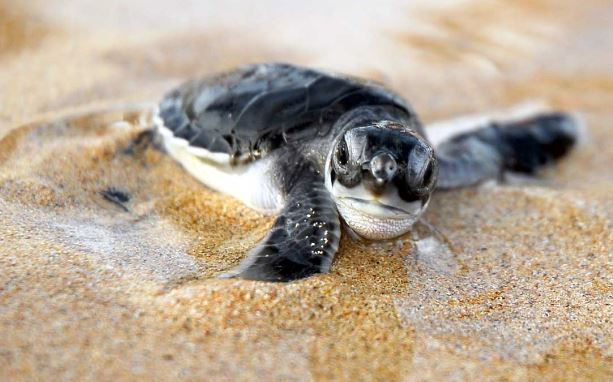
Where do those hatchlings go after they emerge from a nest? During their first three years of life, green turtles develop in the Sargasso Sea, but as they become full juveniles (ages 3 to 10), they inhabit reefs and seagrass beds in waters close to coastlines. As they mature, they are more likely to reside in tropical waters, while fully mature adult green turtles (ages 30 to over 70) mate in migration pathways between foraging and nesting zones.
What is light pollution and how does it impact green turtle hatchlings? Light pollution generally refers to man-made sources of light. Light pollution represents a major threat to sea turtle hatchlings of all species by disorienting them, directing them away from their natural path to ocean water, and leading them to be avoidably killed by vehicles, and dying of exhaustion or by predation as they crawl endlessly on the sand, unable to find the ocean.

What threats do green turtles face? Like all species living in the wild, green turtles face predators, including raccoons and seabirds as hatchlings, tarpon and dolphinfish as juveniles, and larger sharks once they mature into adulthood. Unfortunately, they also face dangers from human impact, including poaching for their meat. Other threats are present in the commercial fishing industry and nets that are discarded (known as "ghost nets"). Boat strikes are a danger, as green turtles typically swim and forage in the shallows. Marine plastics, mostly waste that was not properly discarded, are also a threat to the green turtles. We can all help by picking up plastic and other trash that we see lying on the beach before it is swept out to the open ocean by the tides. The few moments it would take to do so may save a life at sea. “Coastal armoring” occurs when beaches are fortified to prevent beach erosion. Sea walls are an example. However, these barriers can also block beach access to green turtles and prevent them from reaching the beach to lay their eggs.
What is the status of green turtles? In the past, green turtle numbers significantly declined due to harvesting for their meat. However, green turtle numbers have gradually increased since the enactment of the Endangered Species Act, when they were listed in 1978 and large-scale fishing practices ceased. This shows that protection efforts can have a positive impact on turtle numbers.


Comments