
Leatherback Sea Turtle
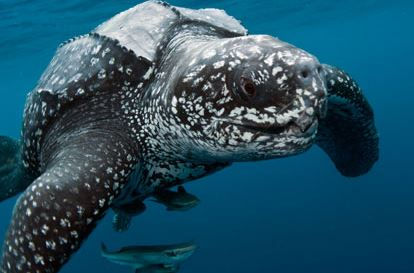
The leatherback turtle (Dermochelys coriacea) is the largest of all sea turtles. They are powerful warm-blooded swimmers that can dive almost a mile deep and endure near-freezing waters.
Here are 10 things to know:
Why are they called leatherbacks? Because they do not have a hard carapace (shell). Rather, their backs are covered by a thick, rubber-like skin that, to people, looks like leather.
How many eggs are there in a leatherback nest? Generally speaking, the average number of eggs in a leatherback nest is around 75. Those eggs take about 60 to 75 days before they hatch. What determines whether a hatchling is a female or male? Sand temperature. Warmer sand produces females; cooler sands, males.
How long does it take a leatherback to lay a nest? It may take a female leatherback between 90 minutes and two hours. That’s how long it takes her to crawl ashore (she's used to being weightless in the ocean), dig the egg chamber, deposit on average 75 eggs per nest, cover them with sand, and then smartly camouflage the nest with assorted lumpy sand mounds to confuse would-be predators.
Where do those hatchlings go after they emerge from a nest? First, it’s a dash to the ocean, with the Sargasso Sea as their destination. There, they forage and evade predators until reaching maturity within 9 years. An adult leatherback can live more than 30 years and can weigh between 600 and more than 1,000 pounds.
What do leatherbacks eat? It’s not tuna or lobster. Instead, they feast on a diet of different species of jellyfish. The menu includes medusae, the translucent, watery and gelatinous animals, as well as salps and Portuguese man-o-war, those floating, stringy hydroids people rightfully avoid being stung by.

How often do adult females lay eggs? After reaching sexual maturity at approximately 25 years, females lay eggs about every 2-4 years. They mate offshore and then return to the beaches where they hatched. But they don’t put all their eggs in one basket, per se. Female leatherbacks can lay anywhere from four to seven nests during a season, usually about 10 days apart. In Florida, the sea turtle nesting season runs from March to October. For leatherbacks, though, it runs mostly from March to June.
Why is Florida’s coastline so important to leatherback sea turtles? For the most part, sea turtles cruising the western Atlantic nest along shorelines of the Caribbean, Central America, and the northern reaches of South America. Leatherbacks also nest in the Sunshine State. Why? It’s not clear. But given that leatherbacks forage in and migrate via waters from north of the Equator to the Arctic Circle, we should consider their nesting here an honor.
How do we know a leatherback has laid a nest? The indicators are tracks from the waterline onto the beach sand with a series of slashes, made by frontal flippers, plus a series of parallel print marks from the back flippers punctuated by a drag-mark made by the tail. They dig a deep body pit and displace sand in all directions after depositing their eggs. Before returning to the ocean, they sometimes crawl in a circle, creating stunning sand art.

What threats do leatherbacks face? Like all species living in the wild, leatherbacks face predators. Unfortunately, they also face dangers from human impact. These include commercial fishing, discarded nets (known as "ghost nets"), as well as lines and hooks. Fishing trawlers and other boats can also drown, injure, or kill sea turtles. Marine plastics, mostly waste that was not properly discarded, are also a threat to the leatherbacks. They confuse plastic bags and balloons for jellyfish, which can suffocate them. We can all help by picking up plastic and other trash that we see lying on the beach before it gets swept out by the tides. The few moments it would take to do so may save a life at sea. “Coastal armoring” occurs when beaches are fortified to prevent beach erosion. Sea walls are an example. These barriers can also block beach access to leatherbacks and prevent them from reaching the beach to lay their eggs.
Leatherbacks are listed as endangered – what does that word mean? The endangered term means that leatherbacks are a species under threat of becoming extinct throughout a portion or the entirety of its range. Threats to their ongoing existence come from poaching by humans or loss of habitat. For leatherbacks, one threat is from light pollution on their nesting beaches, which disorients hatchlings and leads to avoidable mortality. All of the threats faced by leatherbacks are why S.T.O.P. and conservation organizations insist they require ongoing protection under the federal Endangered Species Act.


Comments