
The 25-Year Comeback: How Florida's Green Sea Turtles Returned
The green turtle nesting on a Florida beach tonight began her journey before many of our volunteers were born. Her story is one of the best arguments ever made for the Endangered Species Act, and it is still being written.
Twenty-five to thirty-five years
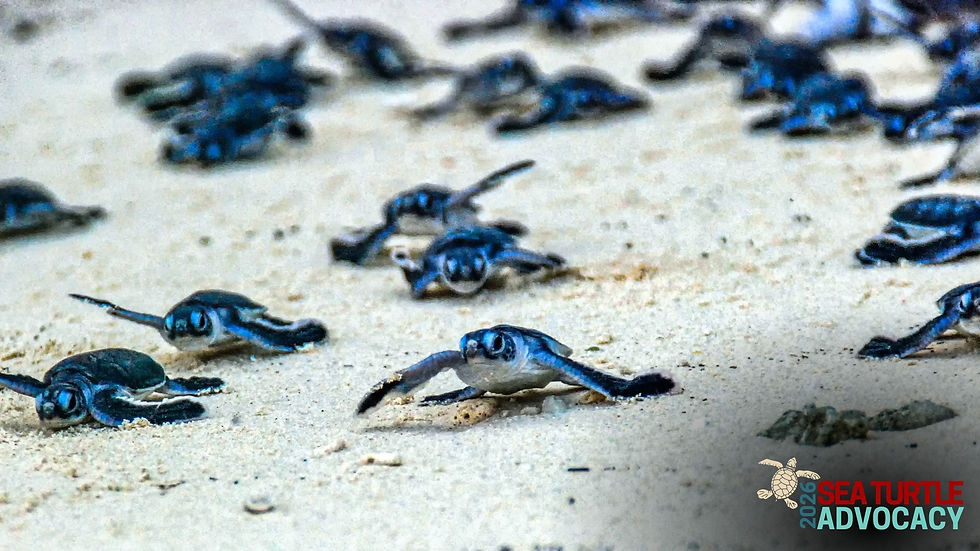
Wildlife agencies put female green turtle maturity at 25 to 35 years, and females return to nest on the same beaches where they were born, sometimes migrating hundreds or thousands of miles to get there. The turtles nesting this season hatched in the 1990s and early 2000s and are second-generation descendants of turtles after the Endangered Species Act protected them in 1978 after the species nearly collapsed. Conservation is a long game. This is how long.
From a handful to thousands
In 1978, Florida's nesting green sea turtle population was nearly decimated and could even be counted in the dozens. Nearly every green sea turtle nesting today hatched after that year — second-generation descendants of the survivors, or the survivors' own children, protected by the Endangered Species Act from birth. By 2016, scientists estimated about 2,250 nesting females a year, according to the Smithsonian. That jump in nesting sea turtle populations validated the impact of having federal protections in place. This miraculous recovery even earned green turtles a downlisting in 2016, from endangered to threatened. Continued improvement of the species' population is only possible with continued protections like the Endangered Species Act.
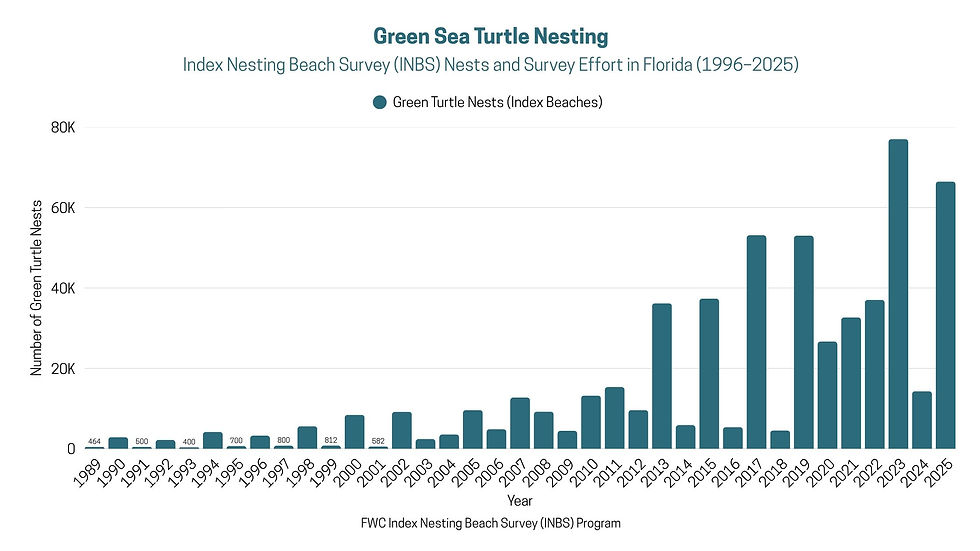
Green turtle nests in Florida rebounded from near-decimation in 1978 to 66,477 nests in 2025. Source: Florida Fish and Wildlife Conservation Commission, Statewide Nesting Beach Survey.
Downlisting is not delisting
You will hear the downlisting used as proof that protections are no longer needed. It is the opposite. It is proof that they worked, and the results are only just beginning to manifest. Threatened still means protected under the law. Downlisting is not delisting, and a comeback in progress is not a comeback secured.
The comeback is bigger than one species
In 2025, FWC counted 2,652 loggerhead nests in Broward County, plus 645 green nests, and our volunteers documented around 1,000 nests on the beaches we patrol in Fort Lauderdale. Statewide, the scale is even bigger: more than 100,000 loggerhead nests, a record 2,012 leatherback nests, and 66,477 green nests, their second-highest season ever. And Kemp's ridleys, the world's most endangered sea turtle, are still hanging on with only a dozen confirmed nests. One law protects all of them.
Read what changed this year, and why it matters for every one of these species.
The turtles nesting today are the result of a decision made in 1978 — just two generations have made it back since. The hatchlings born this season won't nest until the 2050s.

Keep reading
Frequently Asked Questions
Why does it take green sea turtles 25 to 35 years to mature and nest?
Wildlife biologists classify green sea turtles as late-maturing species that spend decades growing in developmental marine habitats before they are biologically ready to reproduce. Because females return to nest on the exact same beaches where they hatched decades prior, today's nesting generations are direct descendants of the survivors protected when the Endangered Species Act was first applied in 1978.
What does "downlisting" a species from endangered to threatened actually mean?
"Downlisting" means a species' population has rebounded enough to step back from the brink of immediate extinction, but it still enjoys full legal protection under the Endangered Species Act. It proves conservation policies work, not that protections can be safely removed.
How do Florida's recent nesting numbers compare to historical lows?
In 1978, Florida's nesting green sea turtle population was so severely depleted that totals could be counted in the mere dozens. By contrast, recent state surveys recorded massive milestones, including a record-breaking 66,477 green sea turtle nests and over 100,000 loggerhead nests statewide in a single season.
Are other sea turtle species recovering at the same rate as green sea turtles?
While green and loggerhead populations have rebounded remarkably over decades, other species face much more fragile recoveries. For example, Kemp's ridleys—widely considered the world's most endangered sea turtle—hang on precariously with only a dozen or so confirmed nests in Florida each year, meaning a single unified law is vital for protecting every species across the board.
How can local communities and volunteers support ongoing nesting recoveries?
Participate in Local Patrols: Groups like Sea Turtle Oversight Protection monitor local beaches nightly during nesting season to protect disoriented hatchlings.
Manage Beach Lighting: Shield or turn off coastal artificial lighting from March through October so hatchlings aren't lured away from the ocean.
Support Conservation Policy: Advocate for maintaining robust federal and state protections that safeguard critical nesting habitats from overdevelopment.
Enjoyed this? Join the mission, and we'll keep you posted through Election Day.
Sources
Washington Dept. of Fish & Wildlife: Green sea turtle species profile: 25 to 35 years to maturity; natal beach homing.
Smithsonian Magazine: Green Sea Turtles Are No Longer Endangered in Florida and Mexico: April 2016 downlisting; handful in 1978 to ~2,250 nesting females.
Phys.org: Green sea turtles of Florida, Mexico no longer ‘endangered’: Threatened status still carries ESA protection.
FWC / Fish and Wildlife Research Institute: Loggerhead Nesting Data 2021-2025 (PDF): Broward County 2025: 2,652 loggerhead nests.
Sea Turtle Preservation Society: Leatherbacks Set New Nesting Record in Florida in 2025: 2025 statewide FWC totals: 100,951 loggerhead; 66,477 green; 2,012 leatherback; 12 Kemp’s ridley confirmed.

Comments